


Views: 0 Author: Site Editor Publish Time: 2026-03-25 Origin: Site


Have you ever plugged a high-end condenser microphone into your setup, only to be met with total silence? You check the cables, adjust the volume, and still hear absolutely nothing. This frustrating scenario happens frequently when audio enthusiasts overlook a crucial component in their signal chain. Condenser mics require an external voltage to operate, and that is exactly where a phantom power mixer comes into play.
Understanding how this equipment functions can completely transform your recording or live sound experience. Supplying a steady +48 volts directly through standard XLR cables allows you to harness the crisp, detailed audio that professional microphones capture. You eliminate the need for bulky external power supplies and streamline your entire setup.
This comprehensive guide explores the essential features you should look for when upgrading your gear. We will cover the mechanics of an audio mixer with phantom power, highlight top specifications, and even showcase a standout model that brings exceptional value to both beginners and seasoned pros. By the end of this read, you will know exactly how to select the perfect phantom power mixer board for your studio or live rig.
Phantom power is a method of transmitting DC electrical current through balanced audio cables. It provides the necessary voltage to operate microphones that contain active electronic circuitry. Most commonly, this applies to condenser microphones, which are highly favored in recording studios for their sensitivity and wide frequency response.
A phantom power mixer integrates this capability directly into the mixing console. You simply press a button—usually labeled "+48V"—and the board sends power down the microphone cable. This design is highly efficient. It powers the microphone without interfering with the audio signal passing through the exact same cable. Dynamic microphones, which do not require external power, generally ignore this voltage, meaning you can safely mix different microphone types on the same board.
Upgrading your audio gear to include built-in phantom power brings several distinct advantages to your daily workflow.
First, it greatly simplifies cable management. You no longer need to wire separate standalone power supplies for every condenser mic you use. The mixer handles everything centrally. This reduces clutter on stage or in your studio, lowering the risk of tripping over excess wires.
Second, it provides remarkable versatility. You can seamlessly switch between dynamic mics for loud guitar amplifiers and condenser mics for delicate acoustic guitars during a single session. Professional sound quality requires capturing a broad dynamic range, and having the right power source ensures your condenser microphones operate at absolute peak performance.
When browsing the market for a new mixing console, phantom power is just one piece of the puzzle. You must evaluate the entire feature set to ensure the board meets your specific live sound or recording needs.
The number of input channels dictates how many instruments and microphones you can connect simultaneously. A solo podcaster might only need two channels. A full band playing live shows might require eight or more. Always buy a mixer with slightly more channels than you currently need to accommodate future growth.
Onboard effects save you from routing your signal through expensive external processors. Look for boards that offer a variety of digital effects, such as reverb, chorus, and delay. Additionally, a robust equalization (EQ) section allows you to shape the tone of each individual channel. You can cut muddy low frequencies from a vocal track or boost the high end for extra clarity.
Modern mixers often feature USB interfaces, Bluetooth connectivity, and SD card compatibility. These connections allow you to stream backing tracks directly from your smartphone or record your mixed audio straight to a computer without needing a separate audio interface.
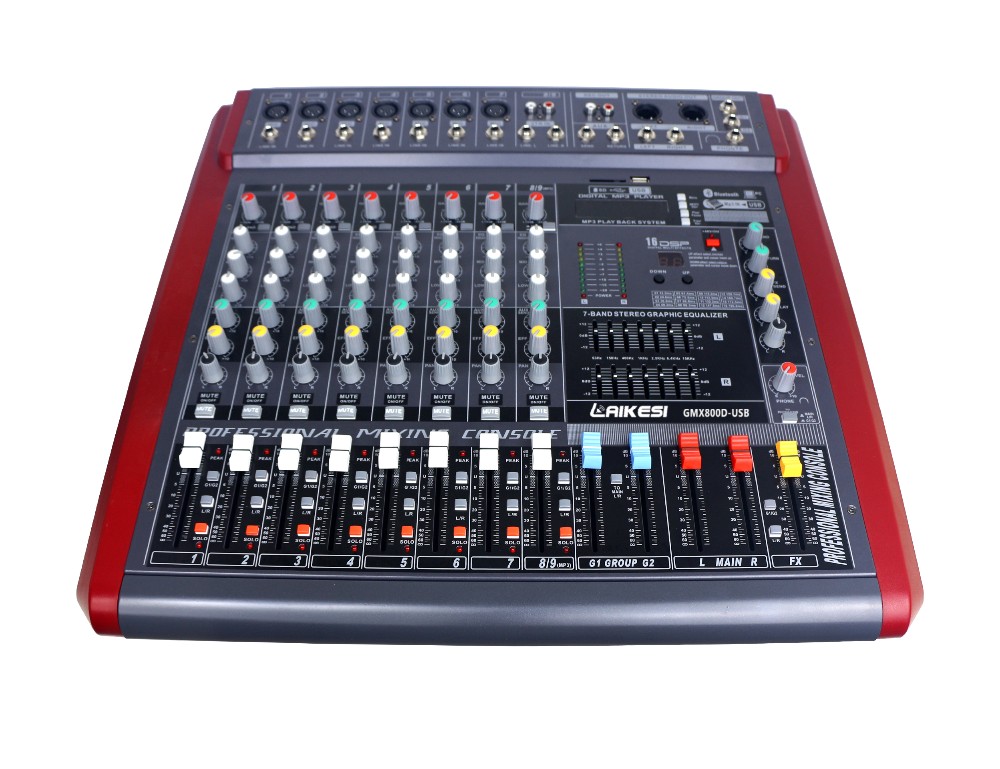
If you want a reliable phantom power mixer board that balances heavy-duty performance with modern digital features, the 2022 GMX800D NEW power audio mixer with 2 Group Control BT USB MP3 is an excellent contender. Manufactured by Enping LAIKESI Audio Technology, this unit packs a massive punch for live venues, rehearsal spaces, and home studios.
This specific audio mixer with phantom power features a rugged, solid appearance designed to withstand regular transport. It includes 7 mono inputs and 1 stereo input, making it incredibly versatile for multi-instrument setups. The built-in +48V phantom power ensures your high-quality condenser microphones perform flawlessly during every performance.
Let us look at a detailed breakdown of its specifications:
Feature / Specification | Detail |
|---|---|
Model | GMX800D |
Input Channels | 7 mono inputs + 1 stereo input |
Phantom Power | +48V |
Output Power | 300W × 2 (4Ω) |
Frequency Response | 20~20kHz |
Equalization | 3 bands per channel + 2*7 bands graphic EQ |
Digital Effects | 16 kinds of digital effects |
Connectivity | USB / MP3 / SD / Bluetooth player interface |
Display | Large 2.0-inch color display |
The GMX800D goes beyond basic mixing by incorporating unique double-ended SMT circuit designing. This guarantees a highly stable performance even during long, demanding live sets. The 60mm high-level analysis faders give you precise control over your volume levels, allowing for smooth fade-outs and careful balancing.
Unlike standard passive mixers, this model includes a built-in amplifier delivering 300W per channel. You can connect your passive PA speakers directly to the back of the board. This drastically reduces the amount of heavy gear you need to haul to a gig.
Using phantom power correctly protects your equipment from accidental damage. Follow a few simple rules to keep your microphones and mixer functioning perfectly for years.
Always mute the channel or turn down the main volume fader before engaging the +48V button. Sending a sudden surge of power to a connected microphone can cause a loud, potentially damaging pop through your speakers.
Connect your XLR cables before turning the phantom power on. Likewise, turn the phantom power off and wait at least thirty seconds before unplugging your microphone. This gives the capacitors inside the microphone enough time to discharge safely. Finally, never use damaged or frayed cables. A short circuit in the cable can damage the microphone's delicate internal components or even harm the mixer itself.
Can phantom power damage a dynamic microphone?
Generally, no. Modern dynamic microphones are wired in a way that ignores the +48V current. You should exercise caution with older, vintage ribbon microphones, however. Sending phantom power to a vintage ribbon mic can easily destroy the fragile metal ribbon inside.
Do I need a separate amplifier if I buy a powered mixer?
It depends on your setup. A powered mixer, like the GMX800D mentioned earlier, has a built-in amplifier. You can connect passive speakers directly to it. If you use active speakers (speakers that plug directly into a wall outlet for power), you should bypass the mixer's amplifier section to avoid overloading the speakers.
Why is my condenser microphone making a hissing sound?
Hissing can occur for several reasons. Check your XLR cable first, as poorly shielded or damaged cables often introduce noise. The phantom power supply might also be delivering inconsistent voltage. Testing the microphone on a different channel or a different mixer can help isolate the exact cause of the problem.
Can I use a quarter-inch TRS cable for phantom power?
No. Phantom power requires a balanced XLR connection to work properly and safely. The design of an XLR cable ensures the voltage travels correctly along the audio pins without shorting out against the ground.
Selecting the right audio equipment fundamentally changes the quality of your sound output. Moving from basic dynamic mics to studio-grade condenser microphones is a massive leap forward, and a dedicated phantom power mixer is the bridge that makes it happen.
By understanding the specifications that matter most, you can make an informed purchasing decision. Look for adequate channel counts, robust equalization, and modern connectivity options. Units like the GMX800D demonstrate how accessible professional-grade features have become, combining heavy-duty amplification with delicate vocal processing capabilities.
Take a moment to evaluate your current setup. Identify the bottlenecks in your signal chain and determine exactly how a phantom power mixer board can streamline your workflow. When you are ready to upgrade, you will be well-equipped to choose a board that brings your audio projects to life with stunning clarity and power.


